When Your Back “Suddenly” Gives Out: How the Body Compensates and How Osteopathy Can Help
Osteopathic Treatment Leg Length Discrepancy
January 15, 2025When Foot Numbness Starts in the Back: An Osteopathic Case Story
December 19, 2025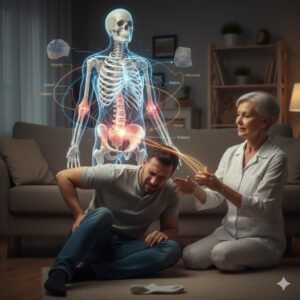
People often tell me, “All I did was bend to brush my teeth, and my back went out,” or “I just sneezed and ended up on the floor.” It sounds like a tiny movement caused a huge problem. In reality, that small movement is usually just the last straw on a system that has been quietly struggling for a long time.
Your Body: A Genius of Self-Correction
One of the core principles in osteopathy is that the body is a self-regulating, self-healing system. It has its own intelligence. When something isn’t working properly, the body first tries to correct it. If it cannot correct it, it looks for the next best option: compensation.
A compensation is the body’s way of reorganizing things so you can continue to stand, walk, and function, even when there is an underlying problem. It is a brilliant survival strategy—but it comes with a cost.
A Simple Example: The Fall on the Tailbone
Imagine you’re a child and you slip and land hard on your bottom. The impact subtly lifts one hip higher than the other. Now your pelvis is a little tilted.
Your centre of gravity, which ideally runs down the middle of your body, has shifted to one side. Your head may tilt slightly; your spine may lean a bit. If nothing else happened, you would feel off-balance.
So what does the body do? It adjusts. It gently side-bends the spine to the same side and tightens some muscles while lengthening others and, almost miraculously, brings your line of gravity back toward the centre. You stand “straight” again.
From the outside, you look fine. Inside, you are working harder. Certain muscles are always on duty; joints are slightly compressed on one side and overstretched on the other. You do not choose this. It happens automatically.
Three Common Sources of Compensation
Over the years, several types of events can create these compensations and even layer them on top of one another:
- Trauma
- Falls, sports injuries, car accidents, whiplash.
- These can abruptly shift your structure and centre of gravity.
- Habits and Posture
- Long hours sitting, slouching over a computer or phone, repetitive tasks.
- Over time, the spine compresses, the chest may collapse, and the back loses elasticity.
- Genetic or Structural Factors
- Mild or moderate scoliosis (a curvature of the spine).
- Even if the curve is small, the body must find a way to adapt to this built-in asymmetry.
Any one of these can create a compensation. Many people have more than one: a genetic curve, plus years of sitting, plus an old fall. The body copes—until it can’t.
When “Nothing” Sets Everything Off
This is why someone can say, “I just bent down to pick up a sock and my back seized,” or “I woke up and couldn’t move.” The bending or sneezing is not the real cause; it is the trigger that exposes how close to the edge your body already was.
For a long time, compensations are often asymptomatic:
- You may feel slightly more tired.
- You may notice minor stiffness now and then.
- Or you may feel nothing at all.
But the underlying pattern keeps costing you energy and gradually increases mechanical stress in certain weak points: where a curve is at its maximum, where it changes direction, or where joints are already a bit vulnerable.
What an Osteopath Looks For
My job as an osteopath is not just to chase the place that hurts. If I only treat the painful area, I might miss the real driving forces.
Instead, I look for:
- The layers of compensation (old injuries, structural curves, postural habits).
- The key weak points (the apex of a scoliosis curve, the junctions where curves change direction, compressed segments in the lower back).
- The relationship between the area of pain and the rest of the body.
With gentle, manual techniques, I work to:
- Restore mobility where the body is stuck or compressed.
- Release muscles and fascia that are working too hard to maintain a compensation.
- Reduce strain on the “pivot points” of a curve or old injury.
We cannot always erase something like scoliosis, especially in adults. But we can often mitigate its effects. That means making it easier for your body to carry that curve with less strain.
Even an improvement of 5–10% can be enough to calm symptoms significantly. When the whole system is better organized, the back feels straighter, breathing often improves, and the nervous system is less irritated.
Why I May Not Treat Only Where It Hurts
If you come in with lower back pain but I also find a long-standing curve, a pelvic tilt, or a compressed upper back, I will not limit my work to your painful lumbar segment.
Pain is often where you are losing the battle, not where the original problem started.
So in treatment, I may work on:
- The pelvis and hips (to rebalance your base).
- The thoracic spine and ribs (to restore mobility above the problem).
- The neck and head (because they also compensate for what happens below).
Over a series of treatments, the goal is to unravel these layers of compensation and leave you with a body that must “work less hard” to hold you upright.
Moving Smarter: Exercise Choices That Respect Your Spine
Hands-on treatment is only part of the solution. If your spine is compressed or you have scoliosis, certain exercises can either support or sabotage your progress.
In many cases, I will recommend:
- Leg press and guided machines instead of heavy squats and deadlifts, which load the spine vertically.
- Gentle standing practices, such as Chi Kung/Qigong-style stances, where you hold stable postures for 10–20 minutes. These can build deep muscle endurance in a safer way for a vulnerable back.
- Avoiding excessive vertical compression (heavy bars on the shoulders, maximal lifting) when you know your spine is already misaligned.
The idea is not to make you fragile, but to train smart, in a way that works with your structure instead of against it.
Bringing It All Together
When your back “suddenly” gives out, it is rarely about that one movement. It is usually about years of small adaptations, compensations and unaddressed stresses that finally reach their limit.
Osteopathy offers a way to:
- Understand how your body has been compensating.
- Gently reorganize those patterns.
- Help you move with less pain and less effort.
If you live in the Montreal/Outremont area and this picture sounds familiar—recurring back pain, “mystery” spasms, or known scoliosis—I would be happy to assess your situation and see whether osteopathic treatment could help you.