When Scoliosis Affects More Than the Spine: Breathing, Rib Mobility, and Even Sinus Congestion
When Foot Numbness Starts in the Back: An Osteopathic Case Story
December 19, 2025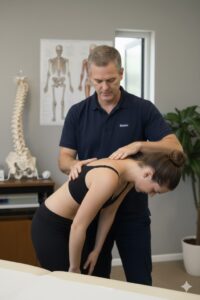
Patient Forward Bending Assessment
Most people think scoliosis is simply a “curve in the back.”
But in clinical practice, scoliosis often behaves more like a whole-body pattern—one that can influence the rib cage, shoulder balance, neck tension, and sometimes even how freely you breathe.
Over the years, I’ve followed a young adult with a stable, moderate thoracic scoliosis (mid-back curve). Interestingly, her biggest challenges were not always pain. At times, she had little or no back pain. Instead, she experienced periods of upper back tightness, neck and shoulder tension, and episodes of “heavy” breathing, often accompanied by a congested, nasal-sounding voice.
What the imaging meant (in plain language)
Her X-rays confirmed a thoracic scoliosis without alarming findings such as fractures or destructive changes. That’s important. It tells us the curve is present, but it also suggests that many of the symptoms—especially when they come and go—are often related to mechanical strain and restricted mobility, not a dangerous or rapidly worsening condition.
Why scoliosis can affect breathing
Your ribs and thoracic spine are designed to move with every breath. When the mid-back and ribs become stiff or slightly rotated—as often happens with scoliosis—the rib cage may not expand as easily. People may describe:
- A sense of compression in the upper back or chest
- Difficulty taking a deep breath
- Tightness that increases with stress, studying/desk work, or during a cold
In other words, the lungs can be healthy, but the “container” around them is moving less efficiently.
Where sinus symptoms can fit into the picture
Sinus congestion is not always infection. Mechanical factors can matter too—especially around the upper neck, cranial base, facial bones, and soft tissues that influence pressure and drainage. In this case, the patient had a history of enlarged adenoids and recurring nasal congestion. Gentle osteopathic work directed at these regions—combined with improving rib and upper thoracic mobility—often correlated with her reporting easier breathing and improved comfort.
What osteopathy can (and cannot) do for scoliosis
Osteopathy does not promise to “straighten” a structural scoliosis in a few sessions.
What it can do, and often does well:
- Reduce excessive tension through the ribs, spine, shoulders, and diaphragm
- Improve mobility so the body compensates more comfortably
- Support breathing mechanics by freeing the thorax and upper neck
- Help reduce the frequency and intensity of flare-ups caused by stiffness and strain patterns
A sensible approach for stable scoliosis
For many patients, the best plan is practical and staged:
- A short series of visits to reduce tension and restore mobility
- Reassessment of how the body is adapting (posture, rib motion, breathing ease)
- Spaced follow-ups when needed—especially during symptomatic periods
- Collaboration with medical monitoring when appropriate (particularly for younger patients)
When to seek urgent medical care
If symptoms include significant trauma, fever, unexplained weight loss, new numbness/weakness, major balance changes, or chest pain that feels cardiac, seek medical evaluation promptly.
The takeaway
Scoliosis is often less about “pain in a curve” and more about how the body adapts—especially through the ribs and breathing mechanics. Osteopathy can be a gentle, practical way to help the body move and breathe with less effort, while supporting long-term comfort and function.