
Heavy Legs After a Hip Replacement: How our clinic; Osteopathy Montreal Can Help You Feel “Normal” Again
When Scoliosis Affects More Than the Spine: Breathing, Rib Mobility, and Even Sinus Congestion
January 5, 2026When the Body “Changes the Rules” After Surgery: Migraines, a Tight Back, and a Nervous System That Won’t Settle
April 16, 2026You did the hard part: the surgery is behind you, the hip is replaced, and walking is slowly improving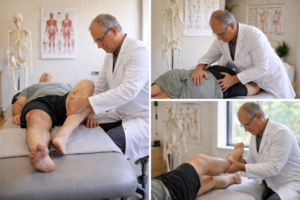
And yet… your legs still don’t feel like your legs.
Many people describe a lingering sensation of heaviness, stiffness, or a “congested” feeling through the thigh, around the knee, or even down into the lower leg—often more noticeable on the operated side. Sometimes the hip itself feels “fine,” but the body still feels off.
This is a classic situation we treat in our clinic: ‘Osteopathy Montreal’ after a total hip replacement, the body often keeps protecting the area—and that protective pattern can persist long after the incision has healed.
Why your legs can feel heavy even when the hip is “fixed”
A hip replacement changes more than a joint. It changes how your body:
- loads the pelvis,
- stabilizes the low back,
- uses the thigh muscles and fascia,
- and coordinates your walking rhythm.
After surgery, it’s common for the body to “hold” tension to keep you safe. Over time, that holding can create:
1) Pelvis and low-back compensation
If the hip isn’t moving smoothly yet (or if you’re still guarding it), your pelvis and lumbar spine often compensate. This can show up as pressure in the low back—sometimes very local, like a pinpoint spot that flares with walking or standing.
2) IT band and fascial tightness (outer thigh)
The iliotibial band (IT band) is thick connective tissue along the outside of the thigh. When it tightens, it can feel like pulling, stiffness, or “fullness” around the hip, thigh, or knee—especially during longer walks.
3) “Pump” mechanics and the heavy-leg sensation
Walking, breathing, and pelvic motion act like natural pumps for tissue fluid dynamics. When gait becomes protective (shorter stride, less hip extension, asymmetrical weight-bearing), people may perceive a heavy, tired, congested leg.
4) A more reactive tissue environment
If you have factors like inflammation sensitivity, chronic stress, or metabolic issues, the tissues may stay reactive longer, which can amplify the sensation of tightness and heaviness.
At Clinique Ostéopathie Montréal (Outremont), we don’t treat this as “just a hip problem.” We assess the full chain that commonly drives the heavy-leg pattern:
- Hip mobility and how the femur is gliding
- Pelvic balance and sacroiliac mechanics
- Lumbar restrictions linked to guarding
- Myofascial tension (often IT band, gluteal region, adductors)
- Ribcage/diaphragm mechanics (because breathing affects pressure systems)
- How your walking strategy is organizing your whole body
How osteopathic treatment can help
Osteopathic care is typically gentle, precise, and progressive. The goal is to help the body stop bracing and start distributing load normally again by:
- reducing protective tension around the pelvis and low back
- releasing key fascial restrictions (including the IT band region)
- improving mobility so the leg can move without “dragging”
- supporting more efficient breathing and walking mechanics
Over time, many patients report that the leg feels lighter, walking feels less effortful, and the “congestion” sensation fades.
When to seek medical evaluation first
If heaviness is accompanied by concerning signs—significant swelling, color/temperature change, calf pain, sudden worsening, chest pain, or shortness of breath—medical evaluation is essential to rule out vascular issues.
The takeaway
A hip replacement can be successful—and your body can still be stuck in a protective pattern.
If you’re experiencing heavy legs, stiffness, or low-back pressure after surgery, an osteopathic assessment can clarify what’s mechanical, what’s myofascial, and what may require referral.
Looking for Osteopathy in Montreal?
Book an appointment at Clinique Ostéopathie Montréal.
